
I swear, there are days when the only actual news I read comes from Ruth Holladay’s blog.
If you don’t know her, Ruth is a “former employee of the Indianapolis Star” … which has become one of those “fastest growing segment” demographics, I’m afraid. Nevertheless, Ruthie was at the Star when it was owned by the Pulliam family, and Gannett was something far away and unimaginable . Shortly after leaving the Star, Ruth launched a blog called, “Ruth’s Blog: All the news not fit to print.” It’s widely read by folks like yours truly who, at one time, made their living as reporters and editors.
Earlier in the week, her post included the news that the Star was losing three reporters including health reporter Dan Lee who I’ve had the pleasure of working with on several occasions. He will be missed.
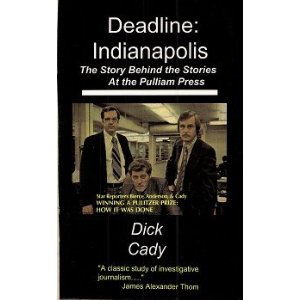 But today I learned that one of my “journalism super heroes” – Dick Cady – has recently published his memoir, “Deadline: Indianapolis — The Story Behind the Stories At the Pulliam Press.” (You can go to Amazon and order a copy … I’m hoping for another book signing soon.) According to Ruth, it gives the “inside scoop” on the Star of old, with a spotlight on the 1970s Pulitzer Prize winning investigative articles regarding the Indianapolis Police Department.
Wait, what? Issues with IPD? Yes, it’s true. The last two years of headlines dribbling out improprieties among the now Metropolitan Indianapolis Police Department and causing local ire have had an odd, familiar ring to those of us who remember Cady and his team who spent six months of real investigative digging. Their work resulted in an expose that rocked the city and forced then-Mayor Richard Lugar to clean up the department. For a national overview of the series, click here to read an archived report from Time magazine. It may prompt you to buy the book.
What I can’t help but wonder is this: How would things be playing out in Indianapolis if the Pulliams still owned the Indianapolis Star? Not that they were perfect, but what would happen if reporters were allowed, even encouraged to dig around for an extended period of time?
On behalf of the folks left at the Star who are often maligned, put your feet in their shoes: You try to do your job and six of your coworker’s jobs that have been eliminated with the same accuracy, timeliness and passion of a few decades ago. Have the “newsroom” turned into the “information center.” And take a couple of weeks of unpaid vacation while you’re at it IF you want to keep that job. So do not blame the lack of in-depth reporting on the reporters or even the local editors. It’s from corporate headquarters located in a D.C. suburb folks, not from 307 Pennsylvania Street (that’s the local address of the Star).
It’s a serious issue. The profession of Journalism in America was grounded in the concept of unbiased, independent reporting; it’s supposed to act as a watchdog of our government. Honestly, its function really wasn’t to make shareholders happy. And no, “citizen blogs” and comment boards don’t replace this function. Because the kind of investigative journalism that Cady’s team did was an investigation of facts by an objective group of people. And it prompted reasonable discourse. But that’s a topic for another day.
So, a few Friday ramblings from someone who can’t help but identify with Jimmy Buffett’s “Pirate Looks at 40.
Mother, mother ocean, after all the years I’ve found
My occupational hazard being my occupation’s just not around
Aw, hell, let’s just all listen to the whole song. What better way to start the weekend? And well wishes to Ruth who is having a little eye surgery that will keep her off line a few days.


 Pickettwrites
Leave a comment